
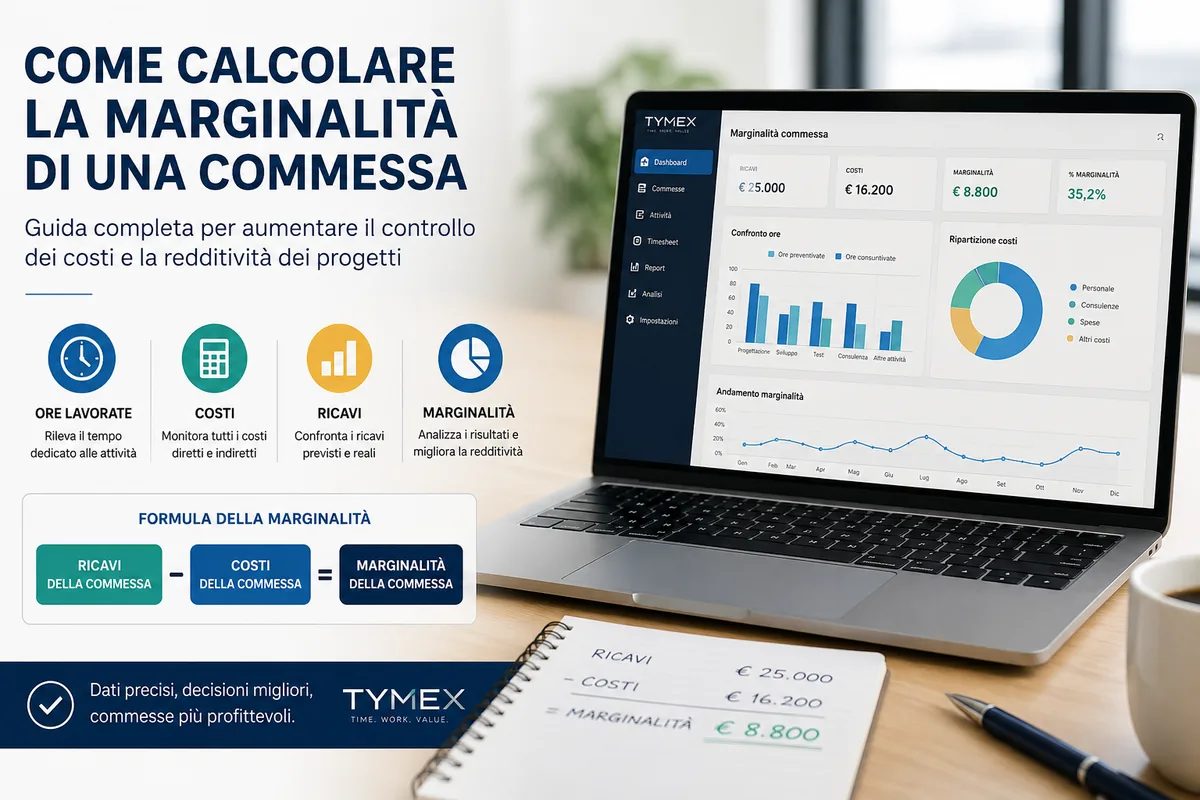
What is a job's profit margin
A job's profit margin is the difference between the revenue generated by a project and the costs incurred to deliver it. It is one of the most important indicators for companies that work by the job, because it shows which activities generate profit and which reduce the company's profitability.
Many businesses know the revenue a job brings in, but have no precise view of its actual costs. This makes it hard to make the right decisions and improve financial performance.
Why it matters to monitor margins
Controlling margins lets you:
- identify the most profitable jobs
- spot activities that absorb too many resources
- make quotes more accurate
- plan work better
- increase company profitability
Companies that monitor margins regularly make better-informed decisions and reduce hidden losses.
How to calculate the margin
The basic formula is very simple:
Margin = Job revenue - Job costs
To get a reliable figure, however, you need to know all the costs incurred precisely.
The main costs include:
- hours worked by staff
- costs of external contractors
- materials used
- travel
- overheads attributable to the job
The role of hours worked
In most service companies the main cost is people's time.
If hours worked are not recorded properly, it becomes impossible to know the real cost of a job.
That is why time tracking is the foundation of management control.
Budgeted and actual hours
One of the most common mistakes is comparing only revenue with the initial estimated cost.
For a correct assessment you need to compare:
- budgeted hours
- hours actually worked
- estimated costs
- actual costs
When actual hours exceed budgeted hours, the job's margin tends to shrink.
A worked example
Suppose a job worth €10,000.
Quote:
- 100 hours of work
- average hourly cost €40
Expected cost: €4,000
Expected margin: €6,000
If the project actually takes 160 hours instead of 100:
Actual cost: €6,400
Actual margin: €3,600
The job is still profitable, but the margin has fallen by 40%.
How to improve job control
To improve margins it's important to:
- record hours every day
- link activities to the right jobs
- monitor variances
- analyse the causes of inefficiencies
- update quotes regularly
How Tymex can help
Tymex is timesheet software designed to track hours worked on jobs.
With the mobile app and the web interface, technicians, consultants and staff can log activities and hours in a few seconds.
The information collected lets the company:
- control costs and time
- compare budgeted and actual figures
- monitor job margins
- improve management control
Conclusions
A job's margin depends not only on revenue but above all on the ability to control the time and resources used.
Accurate tracking of hours worked is the first step to understanding project profitability and making decisions based on real data.
If you want to improve control over your jobs, Tymex can help you collect precise, up-to-date information to analyse costs, activities and margins.